Commercial construction estimating is the bedrock of every profitable building project in Canada. Whether you are a general contractor bidding on a new office complex in Toronto or a developer evaluating a mixed-use site in Vancouver, the accuracy of your numbers dictates your future. A precise estimate determines if a project finishes in the black or becomes a financial burden.
We have seen firsthand how a solid estimate does more than just win a bid. It sets the roadmap for the entire construction schedule and procurement strategy.
In this guide, we break down the mechanics of commercial estimating and the specific Canadian standards you need to know. We will also explore why contractors who prioritize data-driven estimating consistently outperform the local competition.
What Is a Commercial Construction Estimate?
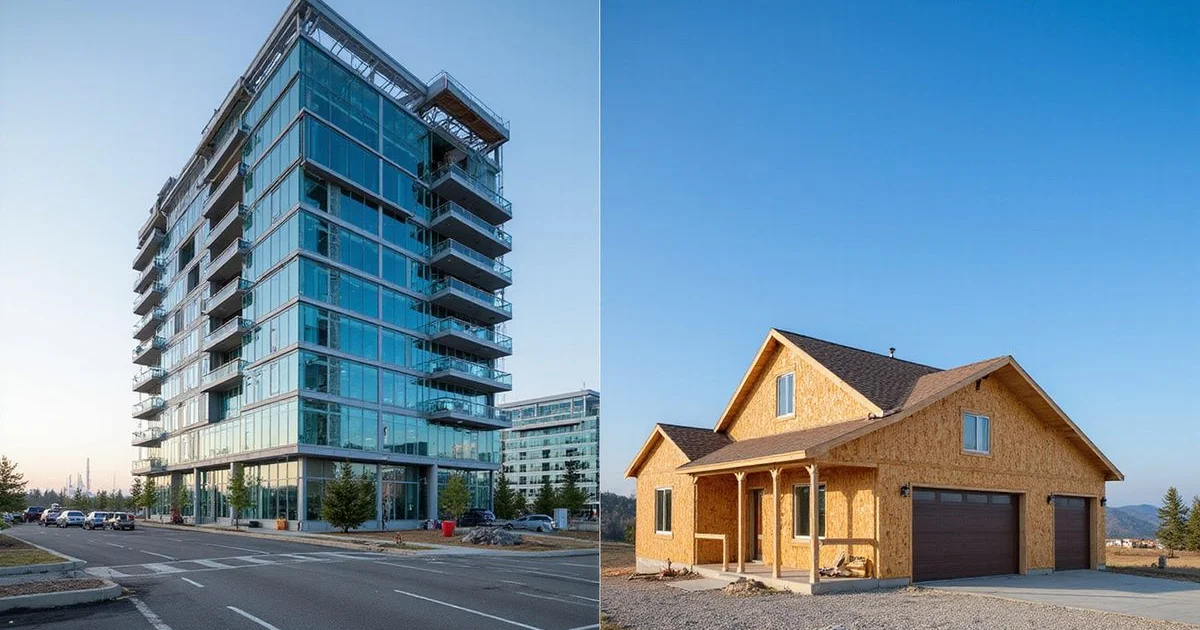
A commercial construction estimate is a comprehensive projection of every cost required to bring a project from drawings to occupancy. This goes far beyond the “napkin math” often seen in smaller residential jobs. Commercial projects in Canada typically fall under Part 3 of the National Building Code (NBC), which demands stricter adherence to fire safety, accessibility, and structural loads than the Part 9 standards used for housing.
Our team approaches this by accounting for complex variables that many overlook. These include structural steel fabrication times, specific MEP (Mechanical, Electrical, Plumbing) configurations, and strict municipal zoning requirements.
A professional commercial estimate includes these five core components:
- Direct Costs: The tangible expenses for materials, labour, and equipment. This includes concrete, steel, and trade-specific machinery.
- Indirect Costs: Often called “General Conditions,” these cover site supervision, temporary fencing, heating (crucial for Canadian winters), and permits.
- Overhead: The operational costs of running your business, including insurance, bonding, and office administrative expenses.
- Profit: The calculated margin you intend to earn.
- Contingency: A calculated financial buffer. We recommend specific percentages based on the project’s complexity to handle unforeseen site conditions.
The Commercial Estimating Process
Creating a reliable number is a scientific process, not a guessing game. We follow a rigorous four-step workflow that aligns with standards set by the Canadian Institute of Quantity Surveyors (CIQS).
1. Document Review and Scope Analysis
The process starts with a deep dive into the construction documents. We examine architectural drawings, structural plans, and the project manual (specifications).
Missing a single detail here can cost thousands later. For example, a note on a structural sheet regarding “high-strength concrete” significantly changes the price per cubic metre compared to standard mixes. We identify every scope of work and clarify discrepancies through Requests for Information (RFIs) before putting a price on paper.
2. Digital Quantity Takeoff
Modern estimating requires precision tools. We utilize software like Bluebeam Revu or PlanSwift to digitally measure every component of the building.
This step eliminates manual scaling errors. Our material takeoff process calculates the linear feet of wall partitions, the square footage of flooring, and the cubic yards of excavation required. Accuracy here is vital. A discrepancy of just 5% in drywall quantity on a multi-storey tower can swing the budget by tens of thousands of dollars.
3. Cost Application with Regional Data
Once the quantities are known, we apply current pricing. Relying on outdated price books is a common pitfall.
We combine historical data with real-time market quotes. In Canada, material costs can vary wildly between provinces due to transportation logistics. We also factor in local labour rates, distinguishing between union and open-shop environments, and account for current collective bargaining agreements that might affect wage rates during the project timeline.
4. Assembly and Peer Review
The final step involves organizing the data into a clear, readable format. Most industry professionals expect this to be arranged by the CSI MasterFormat (e.g., Division 03 for Concrete, Division 26 for Electrical).
Before any estimate leaves our desk, a senior estimator conducts a logic check. This “sanity check” ensures that the ratios make sense—for instance, checking if the electrical cost per square foot aligns with similar completed projects in the area.
Why Accurate Estimating Matters
Margins in the Canadian construction industry are notoriously tight. Recent data suggests that the average net profit margin for general contractors hovers between 2% and 5%.
This leaves almost no room for error. A missed scope item or a miscalculation of 3% doesn’t just reduce profit; it can eliminate it entirely.
Here is how accuracy impacts your business reality:
| Consequence | The Impact on Your Business |
|---|---|
| Underbidding | You win the job but lose money. You are forced to cut corners or fight for change orders, which damages your reputation with architects and owners. |
| Overbidding | You price yourself out of the market. You spend time and resources estimating projects you never win, stalling your company’s growth. |
| Financing Delays | For developers, an inaccurate preliminary estimate can cause lenders to pause or retract funding, stalling the project indefinitely. |
Types of Commercial Estimates
Different stages of a project require different levels of detail. In Canada, these are often referred to by the CIQS classification system (Class D through A). We align our deliverables with these industry standards to ensure clear expectations.
Class D: Order of Magnitude (Concept Phase)
Accuracy: ±20% to 30% This is a high-level calculation used for initial feasibility. We derive this from historical costs per square foot relative to the building type (e.g., warehouses vs. medical clinics).
Class C: Schematic Design (Budget Validation)
Accuracy: ±15% to 20% Design is roughly 15-30% complete. We use this to verify if the architect’s vision aligns with the owner’s budget before detailed engineering begins.
Class B: Design Development (Cost Control)
Accuracy: ±10% to 15% At this stage, major systems are defined. We use this estimate to make hard decisions on finishes and mechanical systems to keep the project on track.
Class A: Pre-Tender Estimate (Bid Ready)
Accuracy: ±5% to 10% This is the final check before going to market. It is based on a complete set of drawings and specifications.
When to Use a Professional Estimating Service
Many contractors handle routine estimates in-house. However, specific scenarios demand external expertise to mitigate risk.
We typically see contractors outsource when they face the following challenges:
- The “Mega” Project: Bidding on a project significantly larger than your usual scope requires more manpower than a single in-house estimator can provide.
- Complex MEP Requirements: A general contractor may know framing, but specialized mechanical and electrical systems often require a specialist’s eye to price accurately.
- Capacity Issues: The labour shortage reported by BuildForce Canada extends to office staff. Good estimators are hard to find, and outsourcing fills that gap instantly.
- Validation: Owners often hire us to provide a “shadow bid” to verify the prices they are receiving from general contractors.
Professional services bring access to expensive cost databases and years of cross-sector data that a single firm may not possess. This results in bids that are aggressive enough to win but safe enough to build.
Getting Started with Professional Estimating
Improving your bid-hit ratio starts with better data. If you are ready to stop guessing and start bidding with confidence, the process is simple.
We review your PDF blueprints and project narrative to understand your specific needs. Within 48 to 72 hours, we deliver a detailed, trade-by-trade cost breakdown.
Every report includes material quantities, local labour rates, equipment costs, and your specified overhead and profit margins. It arrives organized by CSI division, ready for you to drop into your bid form and submit.